
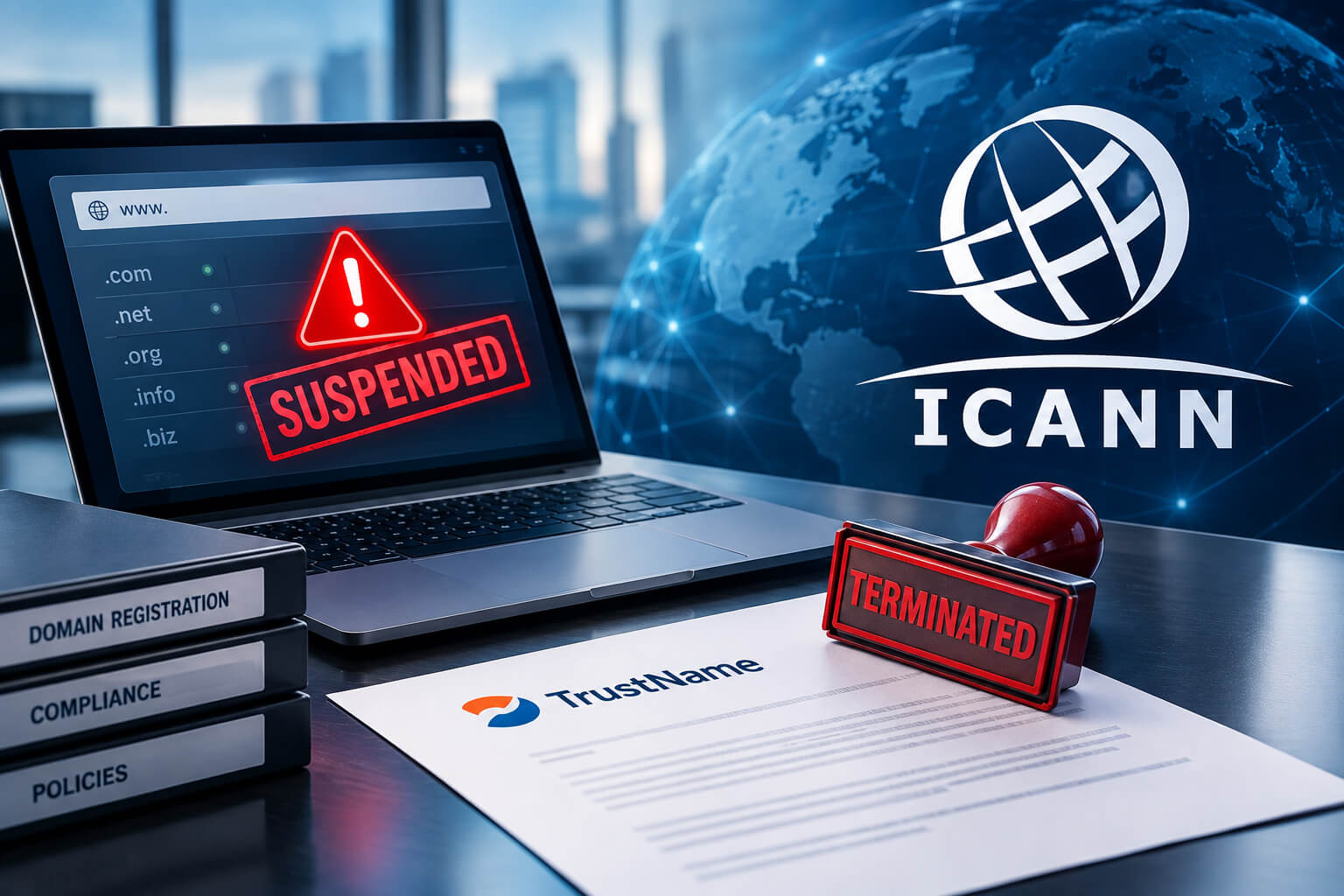
ICANN has terminated the accreditation of TrustName.com, an Estonia-based domain registrar that had marketed itself toward privacy-conscious customers and businesses operating in sensitive or highly competitive niches.
The Internet Corporation for Assigned Names and Numbers took action against Fewmoretaps OU, doing business as TrustName.com, after a series of compliance problems during 2026. TrustName operated under IANA registrar ID 4318.
The decision followed several breach notices rather than one sudden enforcement action. Questions around the registrar’s handling of domain abuse complaints became a central part of the dispute.
For a registrar that once used the word “bulletproof” in its marketing, the outcome is particularly striking.
TrustName Faced Months of ICANN Compliance Problems
TrustName’s problems with ICANN had been building for months before the accreditation was finally terminated. ICANN issued breach notices to Fewmoretaps OU on June 10, June 26, July 16 and August 26, 2026. The repeated notices showed that this wasn’t a one-off disagreement that disappeared after a warning.
ICANN ultimately moved beyond compliance notices and terminated the registrar’s accreditation on August 27. That timeline gives the case more weight. TrustName had multiple opportunities to address the issues raised through ICANN’s contractual compliance process before losing its accredited status.
The “Bulletproof” Registrar Pitch Stands Out
TrustName had built part of its identity around customers who wanted stronger privacy and protection from abuse complaints. Domain Name Wire reported that the company previously described itself as the “most trusted independent domain registrar for privacy-conscious individuals and businesses in sensitive niches.”
Its marketing also used the term “bulletproof” domain registrar. That description stands out now because the company eventually lost the accreditation needed to operate as an ICANN-accredited registrar.
TrustName’s website later softened that language. Its positioning shifted toward serving businesses in competitive niches that may receive false or bad-faith abuse complaints. There is nothing inherently wrong with offering privacy-focused domain services. The problem starts when a registrar’s response to legitimate abuse reports fails to satisfy its contractual obligations.
Domain Abuse Complaints Became a Major Issue
The dispute drew attention to how TrustName handled abuse reports involving domains under its management. Accredited registrars are not expected to automatically suspend a domain every time someone submits a complaint. They are, however, required to maintain processes for receiving and appropriately handling abuse reports.
That creates a difficult balance for registrars. Some abuse complaints can be malicious, inaccurate or designed to pressure a website owner. Others involve serious problems such as phishing, malware, fraud or other harmful activity. Registrars therefore need procedures that protect legitimate customers without simply ignoring credible reports.
TrustName’s compliance problems show what can happen when ICANN determines that those procedures are not meeting the requirements attached to registrar accreditation.
Privacy Protection Does Not Remove ICANN Responsibilities
Privacy has become an important selling point in the domain industry. Registrants may have perfectly legitimate reasons for wanting to limit exposure of their personal information or avoid unnecessary interference with their websites.
But privacy protection and registrar compliance are separate issues.
An ICANN-accredited registrar still operates under contractual requirements. A business can promote itself as privacy-friendly, defend customers against questionable complaints and serve controversial industries, but it still needs to respond appropriately when genuine abuse concerns arrive.
That distinction is important in the TrustName case. The enforcement action should not be read as ICANN taking action against domain privacy itself. The issue was compliance with the responsibilities that come with accreditation.
TrustName Was Relatively Small in the .Com Market
TrustName’s marketing reportedly suggested that millions of domain owners trusted its services, but available .com registration figures painted a more modest picture.
Domain Name Wire cited recent Verisign data indicating that TrustName managed roughly 4,000 .com domain names. That number only reflects .com registrations and does not represent every domain extension that may have been managed through the registrar.
Even so, it suggests TrustName was a relatively small player compared with major registrars managing millions of domains. The importance of the story is therefore less about TrustName’s market share and more about what its termination says about ICANN’s willingness to enforce registrar obligations.
What Happens to Domains After a Registrar Loses Accreditation?
Losing accreditation does not mean registered domains suddenly stop working or disappear. ICANN maintains procedures for situations in which an accredited registrar fails, closes or has its accreditation terminated.
Affected domain registrations can ultimately move to another accredited registrar. The process is designed to protect registrants and keep existing registrations functioning while responsibility for managing them changes hands.
TrustName customers should pay close attention to official communications concerning their domains. Messages about transfers, account access or a replacement registrar become especially important during this kind of transition. Registrants should also verify that the contact information associated with their domains remains accurate.
The Case Sends a Warning to Other Domain Registrars
TrustName’s termination is notable beyond the registrar itself. It shows that abuse-handling requirements are not simply language buried inside an accreditation agreement.
Registrars increasingly operate on the front line of online abuse. Phishing sites, malware campaigns, fraudulent stores and other malicious operations often depend on domain names. That puts pressure on registrars to react without becoming overzealous and taking down legitimate websites based on weak complaints.
There isn’t always a clean answer. Still, ICANN expects accredited registrars to maintain functioning abuse processes and comply with their agreements. Repeated compliance failures can eventually put the accreditation itself at risk.
“Bulletproof” Does Not Mean Untouchable
The most unusual part of the TrustName story may be the contrast between its former marketing and what eventually happened.
Calling a registrar “bulletproof” suggests resilience. For some customers, it might imply that complaints from third parties won’t easily result in domains being suspended. That can appeal to legitimate operators who regularly deal with bad-faith reports.
But no ICANN-accredited registrar operates outside ICANN’s contractual system. A registrar can make its own decisions about customers and complaints within the rules, but accreditation comes with conditions.
TrustName’s experience makes that point rather clearly. Strong privacy positioning may be part of the business model. Compliance still matters.
Domain Owners Should Pay Attention to Their Registrar
Most people register a domain and rarely think about the company sitting between them and the registry. As long as renewals work and DNS settings remain accessible, the registrar largely stays in the background.
Cases like TrustName show why that relationship deserves more attention.
A company’s domain can be one of its most important digital assets. Losing access to it can affect websites, email, customer accounts and an entire online brand. Businesses should know which registrar controls their domains, who holds administrative access and when important registrations expire.
Keeping independent records also helps. Registrar login information, authorized contacts, renewal dates and domain portfolio details shouldn’t exist only inside one provider’s dashboard.
TrustName customers may now have to navigate a registrar transition. For everyone else, the case offers a simple reminder: domain security isn’t only about protecting a password. The stability and compliance record of the registrar matter too.
Sources
- Domain Name Wire — ICANN de-accredits “bulletproof” domain registrar
https://domainnamewire.com/2026/08/28/icann-de-accredits-bulletproof-domain-registrar/ - ICANN — Contractual Compliance Notices
https://www.icann.org/compliance/notices - ICANN — Accredited Registrars
https://www.icann.org/en/contracted-parties/accredited-registrars - ICANN — Information for Domain Name Registrants
https://www.icann.org/registrants